

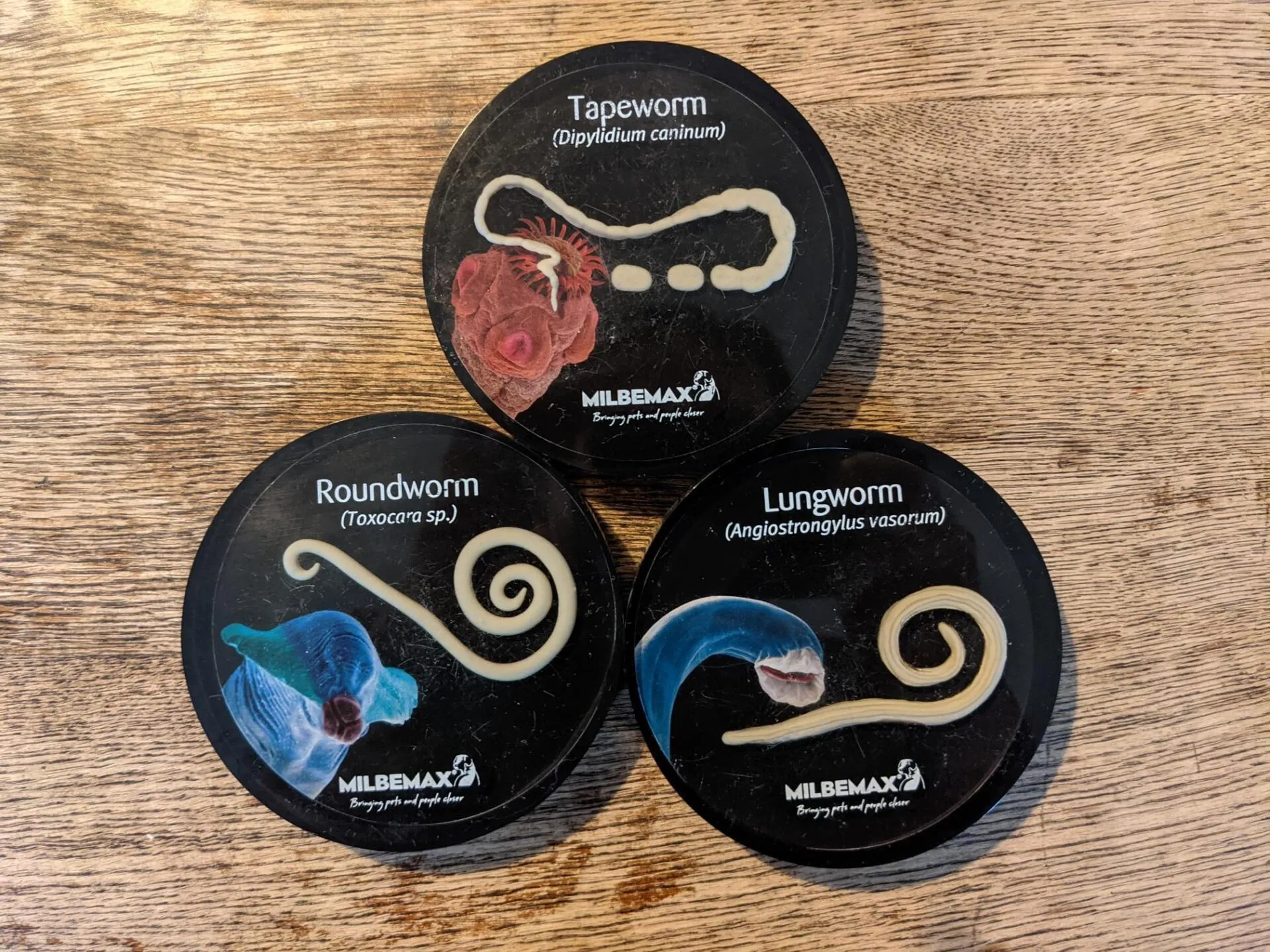
Endoparasites or Internal parasites live, feed and breed inside the pet’s internal organs. They are contracted by ingesting poo and other organisms (including fleas, slugs, snails, mice) and the health problems and disease risk they pose can even be fatal.
Roundworm
- Roundworms are large white worms, with cylindrical bodies.
- The adults live in the small intestine and feed on gut contents.
- Puppies are usually born infected with roundworms; kittens and puppies can also be infected via their mother’s milk.
- Pets can contract roundworm by swallowing infected eggs from the environment.
- If your pet likes hunting, then they can also be at risk of roundworm infections, by ingesting a paratenic host – such as rats or birds.
- Symptoms can include a pot belly, poor coat, diarrhoea and poor growth, but often there are no outward signs.
- This parasite can also affect humans; although disease is not common, it can be devastating as larvae can migrate within the body tissues and in extreme cases have reached the eye causing blindness.
Tapeworm
- Tapeworm look like long, flat ribbons or tapes, divided into segments, and live in the small intestine.
- Once mature, the tapeworm releases segments containing eggs via the cat or dog’s poo.
- Cats and dogs contract tapeworm by ingesting an infected intermediate host.
- Animals may need tapeworm treatment more often if they frequently hunt or scavenge.
- The flea is the intermediate host for the most common tapeworm of dogs and cats, so even indoor cats can become infected by ingesting fleas.
- If your pet has a tapeworm infection, you may not realise as infected cats and dogs often show no symptoms.
- Tapeworm segments in the poo can cause irritation and pets may “scoot” across the ground, symptoms such as vomiting or diarrhoea can also occur.
- In extreme cases, if humans inadvertently ingest some types of tapeworm eggs – cysts can develop within body tissues.
- Dogs travelling abroad must be treated for tapeworm as one European worm is very dangerous.
Lungworm
- Angiostrongylus vasorum (lungworm) resides in the heart and pulmonary arteries and can be fatal to dogs.
- Dogs can become infected with this life-threatening parasite by swallowing infected slugs and snails.
- Slugs and snails can be very small, and can be swallowed accidentally!
- Lungworm reports are spreading with cases now being found beyond the traditional areas.
- Symptoms can be varied but can include coughing, tiring easily, bleeding problems and weight loss. A dog may show one or any combination of these.
- If treatment is initiated early enough, dogs can go on to make a full recovery.
- Even after successful treatment, re-infection is possible so on-going preventative treatment should be considered.
Hookworm
- Hookworms latch onto the intestinal wall and feed on blood, they live in the small intestine.
- In the UK they mainly affect dogs, with cat infections being very rare.
- Animals are infected by ingesting larvae, or a host containing infective larvae, which develop into adult hookworm in the intestine.
- In addition to this, larvae can penetrate skin and cause infection, usually of skin around the foot.
- Symptoms of intestinal infection may include diarrhoea, anaemia, anorexia, lethargy.
- In some parts of the world hookworm can also affect humans through a larval invasion of the skin, which usually occurs in the skin of feet if walking in areas without shoes.
Whipworm
- Whipworms have a thick head end and a characteristic whip-like tail.
- The adults live in the large intestine and in the UK they only affect dogs.
- Whipworms embed their head end into the intestine; they damage the lining and feed on blood and tissue fluid.
- High burdens can cause symptoms such as diarrhoea.
- Dogs become infected by eating eggs in the environment that have been passed in the faeces of infected dogs.
- Infections may also cause anaemia and reduced growth in young dogs.
Heartworm
- Heartworms live in the pulmonary arteries and right-side of the heart of infected dogs and cats.
- They are not found in the UK and Ireland, however they are a threat to travelling pets in Europe and elsewhere in the world.
- They are transmitted by infected mosquitoes.
- If heartworm is contracted whilst travelling abroad, and left untreated, the disease can lead to symptoms such as high blood pressure, heart failure, breathing difficulties, lethargy and even death.
If you suspect there is something wrong with your pet and think it may be an Internal parasite, then please contact us immediately!


